

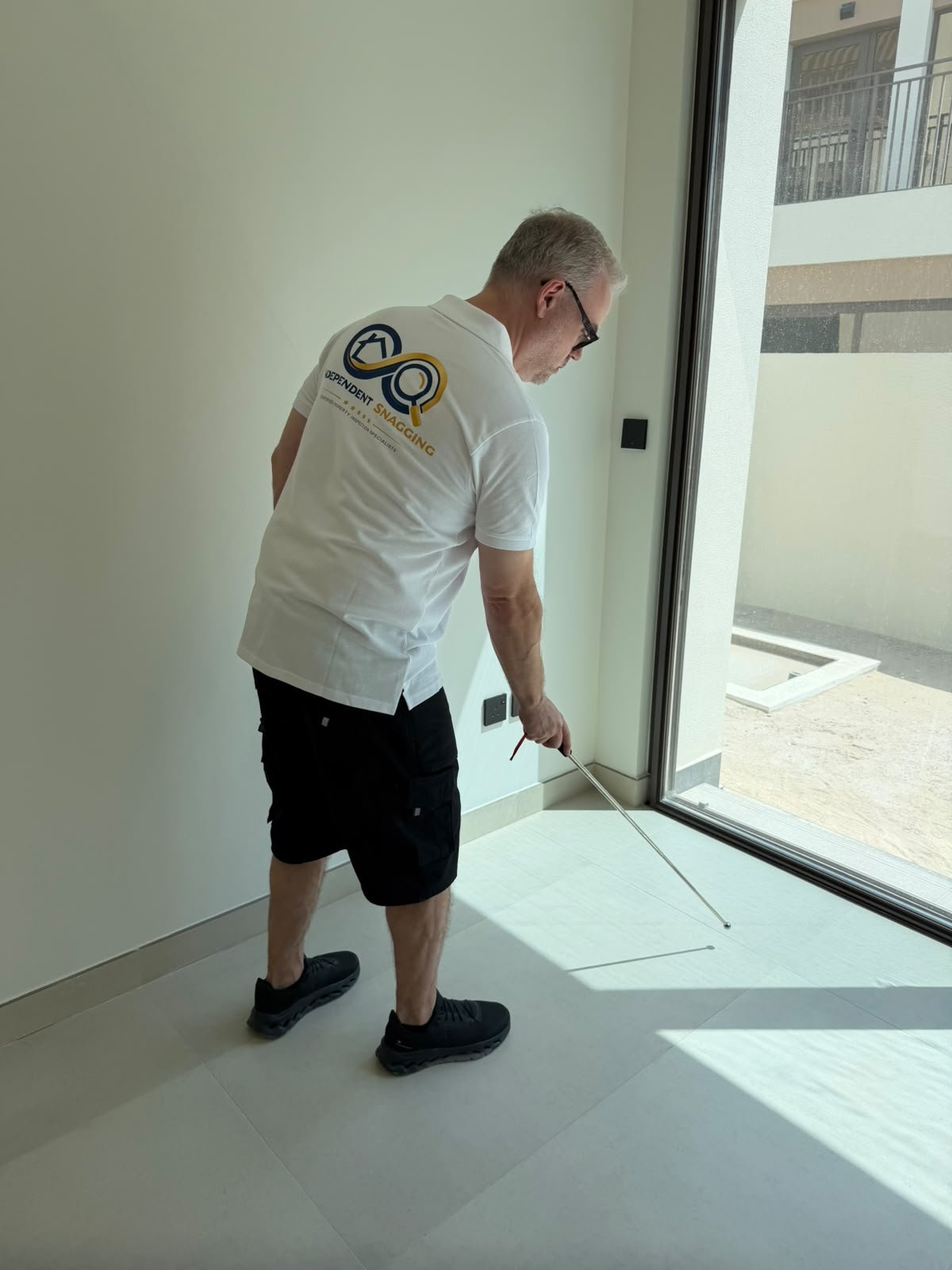
A property inspection in Dubai documents defects in a new build before handover. This home inspection checks finishes, fixtures and accessible systems; property inspectors use photographs and instrument readings to create a snag list for the developer. Property inspection services vary by unit size and scope: indicative fees on this page range from AED 800 to AED 3,500, with a typical apartment visit taking two to four hours. Use this guide to compare inspection services, prepare your property inspection checklist and track repairs before you sign.
Reviewed by Independent Snagging, independent property inspections across all 7 Emirates. Updated 4 October 2026.
Quick answer — the five things to know
- Book it in the 7–10 days before handover. After you sign the final handover certificate and take the keys, the developer rarely fixes cosmetic issues at their own cost.
- Budget AED 900–AED 1,800 for a typical 1–2 bedroom apartment in Dubai; villas and penthouses run AED 2,000–AED 3,500.
- Ask for thermal imaging, not just a visual walkthrough. It is the single biggest reason a snagging report finds defects a buyer’s own five-minute look misses.
- Get the report within 48 hours in a format you can forward: PDF with dated photographs, room-by-room, each defect graded.
- Hire independently. If your agent “arranges” the inspector, ask who employs them. A developer-recommended inspector is not inspecting on your behalf.
At a glance: a studio or 1-bed apartment inspection typically starts from about AED 800; a full inspection of a 1–2 bed apartment takes 2–4 hours on site; and you should insist on the report within 48 hours, before handover.
What is a property snagging inspection, and who needs one?
Snagging means listing the small defects that a building has when it is finished. The word comes from shipbuilding — a “snag” was a rough patch in the hull planking that had to be filed down before the ship was accepted. In property, the defects are usually much smaller: a hairline crack, a tile lip, a scratch on a window frame, a socket that is not level.
An inspection company walks the unit with a checklist, a camera, and a few instruments. They write down every defect, photograph it, grade how serious it is, and hand you a snagging report — also called a snagging list or snag list. You then send that list to the developer or contractor, who is contractually obliged to rectify items before you sign the handover.
Why not just do a normal property walkthrough?
This is the question inspectors hear most. A walkthrough checks what you can see. A proper inspection checks what you can’t: moisture behind a painted wall, a socket that is miswired, a floor that falls the wrong way. That is the whole difference between a walkthrough and a property inspection.
Who actually needs a property inspection?
- Off-plan buyers at handover. The highest-value group. You have leverage only while defects are unfixed.
- Ready/build-to-rent tenants and buyers. Same logic, shorter window — many landlords commission this before a tenancy starts.
- Resale buyers in older stock. Useful but framed differently: you are documenting existing wear, not demanding free repairs.
- Investors flipping a unit. The list becomes your punch list for the renovation contractor and your cost model.
- Overseas buyers. If you cannot fly in for handover, an inspector can attend, document everything and send the report to your inbox.
Snagging is not the same as a home inspection, a survey, or a valuation. A snagging inspection is a short, visual-plus-instrument check of one specific unit. A structural survey or a full building condition survey takes longer, costs more, and is commissioned by lenders and lawyers. If a bank is financing the purchase, ask whether the lender also requires a bank valuation — you may be paying for three separate visits.
What the inspection report is legally for
In Dubai, the developer’s sale and purchase agreement plus the standard handover documentation set out what must be delivered in a defect-free state. Most buyers’ practical leverage comes from three levers:
- The defects liability period on the sale contract (commonly 12 months for major defects, with structural elements often covered separately under the RERA framework).
- The developer’s obligation to rectify before handover where the unit is not of the agreed specification.
- Your right to withhold a small portion of the payment or delay the final handover signature until the agreed items are closed. Ask your lawyer about the exact mechanism before you assume it applies to you.
This is the point most guides get wrong. The report is ammunition, not a legal instrument. Its value comes from being specific, photographed, and delivered while the developer still cares about the handover.
Property inspection cost in Dubai: how much does a snagging inspection cost?
For a standard apartment, expect to pay between AED 800 and AED 1,800 in 2026. Villas, penthouses and large floor plates push that to AED 2,000–AED 3,500. The price is driven by square footage, number of bedrooms and bathrooms, how many floors you want covered, and whether you add services like thermal imaging or a full MEP (mechanical, electrical and plumbing) test.
| Property type | Typical size | Low | High | On-site time | Report |
|---|---|---|---|---|---|
| Studio / 1-bed apartment | 45–75 m² | AED 800 | AED 1,200 | 2–3 hrs | 48 hours |
| 2–3 bed apartment | 90–140 m² | AED 1,000 | AED 1,800 | 3–4 hrs | 48 hours |
| Large apartment / duplex | 140–220 m² | AED 1,500 | AED 2,400 | 4–5 hrs | 48–72 hrs |
| Townhouse | 180–300 m² | AED 1,600 | AED 2,800 | 4–6 hrs | 72 hours |
| Villa (single storey) | 250–500 m² | AED 1,800 | AED 3,500 | 5–8 hrs | 72 hours |
| Penthouse / full-floor | 400 m²+ | AED 2,500 | AED 3,500+ | 8–12 hrs | 72 hours |
The pattern is consistent: cosmetic findings are cheap to fix, and anything involving water is not. That is the argument for paying for thermal imaging and an MEP test rather than for a longer walkthrough.
What changes the property inspection fee?
Size and number of levels
Most companies price on total area including common areas you are entitled to inspect. A villa with a garden, a maid’s room and a roof terrace takes longer than an apartment of the same floor area. Multi-level townhouses and penthouses usually price by the extra floor. Above roughly 200 m², expect a step change in price rather than a linear one, because the crew needs more time. A single comprehensive visit beats two rushed ones.
Added services, and which are worth paying for
- Thermal imaging (+AED 150–400): worth it. Finds moisture behind finishes and missing insulation that look perfectly normal to the eye. Many inspectors now include it at no extra charge.
- MEP testing (+AED 300–500): worth it on any tower or a villa. Checks water pressure, drainage fall, drainage speed, socket voltage, air conditioning output and balcony door operation. Catches the defects with the highest repair bills.
- Drainage camera / leak test (+AED 200–400): situational. Worth it if you suspect a hidden leak or the building has a history of them.
- Asbestos or hazardous-material survey: not part of snagging. Different job, different price, rarely needed in a new build.
Location, access and parking
Inspections in Dubai Hills, Arabian Ranches, Jebel Ali Village and other outer communities may carry a travel charge. High-rise towers sometimes charge for a lift booking or require security coordination in advance. Marina, Downtown and Business Bay are generally easiest. Ask whether the fee includes VAT, and whether rescheduling after a failed access attempt is free.
What should not be in the price
Watch for anyone quoting a suspiciously low number (say AED 300) with no photos in the sample report and a same-day promise. A 20-minute walkthrough with a checklist is a marketing visit, not an inspection. Ask for a redacted sample report before you pay a deposit.
The value test. Nobody buys a snagging inspection hoping to find nothing. The fee is small next to the cost of a water leak, a failed waterproofing layer or a dead electrical circuit found after you have moved in, which is why the expected cost of skipping the inspection is usually higher than the cost of doing it.
Property inspection checklist: what does a snagging inspection check, room by room?
A thorough report walks the unit in a fixed order and covers the same categories everywhere. Here is the checklist professional inspectors work from, grouped the way a good report groups it.
Doors, windows and ironmongery
- Door and window frames level and plumb — checked with a spirit level, not by eye.
- Operation of every door, window, sliding door and balcony door: smooth running, no binding, no rubbing.
- Sealant and gasket condition around frames, and silicone joints in wet areas (check for the gaps that let water into a wall assembly).
- Scratches, chips and paint misses on frames, especially sliding door tracks where they are almost always damaged.
- Door handles, locks and hinges aligned; lock cylinders functioning; keys issued match the units delivered.
- Window drainage and weep holes open.
Walls, ceilings and paint
- Hairline cracks, movement cracks, and cracks around openings or slab edges — photographed with a crack gauge so the developer can see whether they are stable.
- Plaster and gypsum finish: flatness, hollow areas, patched joints, unpainted areas, mismatched paint batches between rooms.
- Ceiling: cracks, sagging, water staining, missing or badly fitted cornice and coving.
- Nail pops, filled screw holes and over-sanded joints — a finish-quality issue, but one that most buyers only notice at handover.
Floor finishes, tiles and grouting
- Tile lippage — the height difference between neighbouring tiles. Measured, not judged.
- Grout: cracks, missing lines, inconsistent colour, failed sealant at junctions (movement joints are the ones that fail first).
- Tile alignment, plane and slope in wet areas — floors must fall toward the drain, never the wrong way.
- Chipped or cracked tiles, and replacement-match risk if a batch is discontinued.
- Timber or vinyl: gaps at edges, swelling, subfloor movement marks.
Kitchen: cabinets, worktops and appliances
- Carcass alignment, door gaps even and consistent, hinges and soft-close functioning.
- Worktop overhang, joins filled, cut-outs sealed, upstand flush with the wall.
- Sink, tapware and mixer working; no leaks at the base; drainage trap sealing.
- Appliances: all present, all powered, all functioning — including the extractor and any built-in oven or hob. Many snags are simply “the oven was never connected”.
- Paint and finish on cabinet interiors; missing handles or end panels.
Bathrooms: the highest-value room in the report
- Water pressure and flow rate at every outlet, including the shower mixers.
- Drainage speed — half a bucket, timed. A slow drain that smells is a defect now and a leak later.
- Toilet: fixings, movement, fill rate, flush, and the back-to-wall gap sealed.
- Waterproofing: flood test of the wet zone floor where access allows, plus thermal imaging of the ceiling below.
- Silicone sealing at every junction; missing or broken sealant is the most common recurring finding in new buildings.
- Mirror, glass shelves, towel rails and accessories fitted and secure.
- Ventilation or an extract fan actually venting outside.
Electrical, plumbing and air conditioning (MEP)
- Socket count and positions against the agreed layout; every socket tested with a voltage tester.
- RCD/GFCI protection in wet areas; switch plate alignment and labelling.
- Lighting: all fittings present, working, and not flickering; missing diffusers or lenses.
- Water heater: operation, hot water at the outlets, safety valve, and the warranty card issued.
- Air conditioning: cooling output measured, air flow, drainage, and whether units are the specified size.
- Balconies: drainage falls and scupper outlets clear, waterproofing upstand present, ceiling finish clean.
- Metering: electrical and water meters present, correctly located and readable — this saves an argument with DEWA later.
Common areas and building-level items
Worth confirming early, because you can only fix these through the developer or the community operator:
- Lobby, corridors, lift interiors, service stairs and parking bay finish level.
- Pool area, changing rooms, gym and children’s play areas where they are part of your entitlement.
- Lift signage, floor numbering and wayfinding to your unit.
- Chiller and cooling charges, service charge statements, and the snagging-related items in the building’s own handover list.
Ask any company for a sample report before booking. A real one is dated, photographed and graded. If the sample is a checklist with no photos, you are buying a signature, not an inspection.
Inspection tools: what do property inspectors use to find defects your eyes cannot?
The gap between a homeowner’s five-minute walkthrough and a professional inspection is not effort. It is instruments. Each tool below answers a question that “it looks fine” cannot.
| Tool | What it detects | Why eyes miss it | Ask for it |
|---|---|---|---|
| Thermal imaging camera | Moisture behind finishes, missing insulation, thermal bridging, water ingress | A wet wall looks dry from the front; the difference only shows as a temperature delta | Yes — should be standard in 2026 |
| Moisture meter | Elevated moisture in screed, walls and behind tiles | Damp reads as “cool” not “wet” until it is a real problem | Yes, in wet areas |
| Pin moisture / resistance meter | Precise reading at a single point | Handheld non-invasive meters can be fooled by surface coatings | Nice to have |
| Digital protractor / level | Out-of-plumb doors and walls, floor fall | A 5mm lean over 2m is invisible but functionally wrong | Yes |
| Crack gauge | Whether a crack is active or stable | You cannot judge movement from a photograph | Ask — it signals a serious report |
| Anemometer | Air flow at vents, extract performance | An extract fan sounds like it is working while moving nothing | On villas and large units |
| Multimeter / socket tester | Socket voltage, wiring faults, RCD trip | A socket that lights a lamp can still be miswired | Yes |
| Borescope / endoscope | Condition of drainage pipes inside walls and behind finishes | The pipe is genuinely hidden | Situational |
| Digital camera + scale reference | Anything, but as evidence | — | Non-negotiable |
| PPE | Nothing — it protects the inspector and your finishes | — | Shoe covers and a dust mask are a good sign |
How should an inspector grade defects, and why does severity decide what happens next?
A snagging report is only useful if defects are ranked. A flat list of 40 items gives a buyer no idea what to fight for. Good reports use three buckets, and the bucket decides the response.
| Grade | Meaning | Examples | What to do |
|---|---|---|---|
| Critical | Health, safety, water ingress or a system that does not work. Cannot be lived in. | Leak, failed waterproofing, no hot water, dead socket, drainage backing up, balcony fall | Rectify before handover. Do not sign until closed. |
| Major | Below specification and visible, but the unit is usable. | Wall not plumb, tile lippage, window scratches, cabinet door gaps, missing sealant runs, wrong AC unit size | Request rectification with a deadline; escalate if missed. |
| Minor | Cosmetic. Will not get worse on its own. | Paint touch-ups, nail pops, chipped edges, small grout gaps | Ask for rectification before you decorate. Never after. |
Filter a real inspection report by severity
When you receive a report, read it by grade rather than by room. Start with every critical item, because those decide whether you can safely sign. Then work through the major items and set a deadline for each. Leave the minor items for last, but still get them on the rectification list before you decorate. A good report makes this easy by letting you see the criticals on their own.
Inspection reports: what should a property inspection report contain, and what happens next?
The nine things an inspection report must contain
- Cover page with unit address, unit number, date, time, inspector name and inspection reference.
- Scope statement — what was and was not inspected, and any area that could not be accessed.
- Summary table of defect counts by severity. This is the page your developer actually reads.
- Room-by-room detail, each defect with a unique reference number.
- A dated photograph for every defect, ideally with something for scale. A photo without scale gets disputed.
- A severity grade per defect.
- Measurement where relevant — crack width, lippage in mm, leak rate, temperature delta.
- Instrument readings and the test method, so findings are reproducible.
- A rectification tracking column so the same report can be used as a sign-off checklist later.
If the report lacks unique reference numbers, do not send it. A flat list of prose observations cannot be tracked to closure. Every defect needs an ID so that “item 14” can be checked off in a second visit. This is the difference between a report that gets defects fixed and one that gets filed.
What happens after the inspection — the sequence that works
- Within 2 hours — send the report to the developer or main contractor. Email it the same day, addressed to the snagging/hand-over team, with a written request for rectification and a response date. Keep the sent email — it establishes the clock.
- Within 24–48 hours — chase, politely, in writing. Most developers respond within a day. If you get nothing, escalate to the project manager, then the sales office, in writing. Verbal conversations at the site office do not create a record.
- Day 3–7 — get a rectification date, in writing. “Soon” is not a date. Ask for a date per severity band: criticals first, then majors, then minors.
- After rectification — book the re-inspection before signing. This is the step people skip, and it decides whether the report was worth anything. Typically AED 300–600, or free if the same company did the original report.
- At handover — record condition at the moment of signing. Photograph and video everything, meter readings included, on the day. Once you sign, arguing about pre-existing minor defects becomes very difficult.
- Within the defects liability period — keep the report and log new issues separately. Post-handover issues fall under the defects liability period, not the handover snag. Do not mix them into one email to the developer — that is the most common cause of delays.
How to run a property snagging inspection from booking to signature
This is a practical plan for a buyer. It takes about two weeks, and the inspection is typically one of the highest-return costs in the whole purchase process.
- Day −30 · Shortlist three independent inspection companies. Ask each for a sample report and a written fee quote. Check the company is independent of your developer and of your agent’s brokerage. Verify credentials — Internachi certification or an equivalent engineer membership is the baseline.
- Day −14 · Confirm the handover appointment in writing. You cannot inspect before the unit is accessible and cleaned. Get the access window from the developer and book the inspection into that window, not after it.
- Day −7 to −3 · Book, with the report deadline in writing. Insist on delivery within 48 hours. A report that arrives after you have signed is a report you paid for and cannot use.
- Day −2 · Send your priorities to the inspector. Tell them what matters: a specific appliance model, a view concern, a balcony you will furnish, a water pressure issue in a tower with known low pressure. Good inspectors go deeper where you point.
- Handover day, first 30 minutes · Attend the walkthrough, then hand over to the inspector. Your presence is what gets items prioritised. Walk it once yourself with the unit switched on, then let the inspector do the detailed work.
- Right after the inspection · Send the report and request rectification dates. Copy the developer, the agent and your own file. Reference numbers matter here.
- Before signing · Re-inspect and only then sign. Book the re-inspection at the same time as the first inspection — the rectification slot tends to fill up in handover week.
- Day 0 · Sign only after the criticals are closed. And take your own dated photographs and video of every surface, plus meter readings, before you hand over any money.
Handover week is when prices spike. Inspection companies tend to be fully booked in the days before a handover date, and same-day slots cost more. Book early, then reschedule if you must — rescheduling is usually free.
Property inspection findings that cost the most: water, drainage and electrical faults
The visible defects are rarely the expensive ones. Anyone can spot a paint miss in ten minutes. A property inspection with thermal imaging and an MEP test is what finds the faults that cost thousands to put right, and most of them involve water or electricity.
Water ingress from roofs, risers and balconies
A leak can run for weeks behind a painted surface before a stain appears. A thermal imaging camera shows the temperature difference of damp material, and a moisture meter confirms it. Typical sources are flat roofs, service risers on the floor above, failed balcony waterproofing and window perimeter sealant. Because new finishes hide the evidence, a new unit is a better candidate for thermal imaging than an old one, not a worse one.
Drainage that slows or backs up under load
A bathroom drain can look fine until it is tested. A timed flood test shows whether water clears at the right speed, and a drain that stands or smells at handover usually becomes a plumber’s call-out in the first months. Floors that fall away from the drain are a related finding that only a level and a water test will confirm.
Electrical circuits and missing protection
Dead sockets, miswired outlets and missing RCD protection in wet areas are safety items, not cosmetic ones. A socket tester and multimeter take seconds per outlet and catch faults that a lamp test misses. Any electrical finding should be graded critical until a qualified electrician confirms it is safe.
Why the cheap inspection is the expensive one
A quick visual check by a developer-recommended inspector can be cheaper, but it tends to find cosmetic items. The independent route costs more because it includes instruments, a longer visit and a graded report written for you. The difference in price is usually small next to the repair bills it can help you avoid.
How to choose a property inspection company in Dubai without getting it wrong
Why an independent property inspector is the whole point
Independent Snagging puts it plainly: no developer deals, no referral arrangements, just your report, written for you and no one else. A developer-recommended inspector is being paid by the developer, on the developer’s schedule, to the developer’s standards. Some are perfectly competent — but the incentive structure is wrong and you should know whose money is on the table. Pay for your own inspector.
The eleven-question filter for choosing an inspector
- Are you independent? Who employs you, and do you work for any developer in this project?
- Can I see a redacted sample report? Photographed, graded, with reference numbers?
- What is in the price? Thermal imaging, MEP testing, and how many visits?
- When exactly will the report arrive? In writing, in hours, not “one day”.
- What credentials do the inspectors hold? Internachi certification, engineering membership, or none.
- Do you test drainage with a timed flood? Or just “it looked fine”?
- Do you list what you could not access? An honest report names its own gaps.
- Do you offer a free re-inspection after rectification? If not, what does it cost?
- Is your report formatted for forwarding? PDF, photo-indexed, addressable to the developer.
- Do you give verbal handover of the findings? A 10-minute call explains severity better than 40 pages.
- Do you carry professional indemnity insurance? Ask for the certificate. It is the simplest trust test there is.
Where to look, and what to verify about an inspection company
- Search by community and service. Search “snagging inspection” plus your community — Business Bay, Dubai Marina, Jumeirah Village Circle, Al Furjan, Palm Jumeirah, Mudon, Nad Al Sheba, Jebel Ali Village, Dubailand — to find inspectors who work those buildings daily. Local familiarity shortens the inspection.
- Check credentials. Internachi certified inspectors, or members of a recognized engineering body. This is the closest thing to a license in this sector.
- Read the reviews for specifics, not stars. Reviews that mention a named community, a defect type and a response date tell you something. “Great service, very professional” tells you nothing.
- Ask for a video walkthrough sample. Companies that publish unedited clips of real inspections are confident in their own work.
- Compare three quotes on the same scope. Line up the base fee, thermal imaging, MEP testing, report deadline and re-inspection cost. If one quote is less than half the others, ask what is excluded.
Your own pre-handover property inspection: a 20-minute checklist
This does not replace an inspection. It does two useful things: it stops you signing something you personally noticed, and it tells the inspector where to look first. Run it with all lights on, the air conditioning running, and every tap and switch operated.
Every room, every time
- Stand in the corner and look along each wall — diagonals reveal sagging and unevenness.
- Look up at the ceiling junctions where walls meet slab. That is where cracks hide.
- Run your hand along sealant lines. Broken or missing silicone is the most common finding in any building.
- Slide every door and window yourself, full open and full closed.
- Check socket plates sit flush and look straight. Anything proud or crooked is a snag.
- Look at the floor in raking light — the lowest sun angle reveals ripples in tile and paint.
Wet rooms only
- Open every tap to full flow. Weak pressure in a tower is often building-wide, but the per-unit contribution is still a defect.
- Look at the base of the toilet and behind the pan for seepage.
- Check the shower head, mixer and glass door seal.
- Run the shower for 5 minutes with the floor drain visible, then check the ceiling below if you can.
- Smell. Drain smells at handover become smells you pay a plumber to remove in month two.
Before you hand over a dirham
- Photograph the electrical and water meter readings on the day.
- Confirm you have every key, fob, access card and warranty document — heater, AC units, appliances, sanitaryware, shutters.
- Check the keys actually operate the correct doors.
- Confirm the unit is fully connected to DEWA services, or find out exactly when it will be.
- Get your own dated photos and video of every wall and floor. It takes a few minutes and settles every future argument.
How to use the inspection report before you sign — and what to check on the contract
The report is only leverage while three things are true: it is specific, it is dated to the inspection, and the handover has not been signed. Once you sign, the game changes completely.
- Step 1 — Read your contract before the inspection, not after. Find the defects liability period, the specification schedule, and the handover conditions. Every defect you log needs to be measured against something written. A scratch is an opinion; a scratch on a finish specified in the contract schedule is a claim.
- Step 2 — Send the whole report, in writing, with a deadline. Lead the email with the criticals and majors. Copy the developer entity, not just the sales person who happens to be on site.
- Step 3 — Ask for a written rectification schedule, not a promise. One row per item, with a date and a named owner. Get the schedule back in writing.
- Step 4 — Re-inspect. Do not trust “done”. Items can be closed on paper without being fixed. Verify each one before you sign.
- Step 5 — If items remain open, take advice before you sign anything. A Dubai property lawyer or your conveyancer can tell you whether a given defect blocks handover, whether a payment should be held, and what the developer is obliged to do. This is a situation-specific question and a short consultation is proportionate.
Never sign “as is” or “in good condition” without understanding what you are accepting. Some handover certificates include language about the unit being accepted in its current condition. If you have already received a report and closed the critical items, that signature carries far less risk. If you have not, you are signing away a list you never even wrote down.
One more thing worth checking. Dubai’s escrow and handover processes are administered through the developer and the Dubai Land Department (DLD), and RERA sets the wider framework for developer conduct and the defects liability regime. If a developer’s response to a snagging list seems unreasonable or the dispute escalates beyond your inspector, that is the point to involve a lawyer rather than another email.
Best for, skip if, and how to pick your own level of service
Not every buyer needs the same inspection. Here is how to match the scope to the situation.
Book a full inspection if…
- You are an off-plan buyer handing over in 2026. This is the group with the most to lose and the most leverage. Full inspection, thermal imaging, MEP test, re-inspection before signature. Do not economise here.
- You are buying a villa, townhouse or penthouse. More area, more systems, more envelope to fail. Roofs, external walls, drainage and landscape levels need a professional eye far more than an apartment does.
- You are a landlord preparing a tenancy. MEP and safety items become your liability the moment a tenant moves in. An inspection is cheaper than a dispute.
A basic inspection is enough if…
- You are buying ready, non-new stock. Nothing is owed to you here, so the value is documentation and negotiating power on price. A visual walkthrough with photographs is usually enough; add thermal imaging if the building is old or you suspect water ingress.
Skip it if…
- You will not act on the report. If you will sign regardless of what is found, you are paying for information you will not use. Either commit to acting on it, or skip it.
- You hope it will replace a lawyer. An inspector identifies defects. A lawyer tells you what to do about them in a contract dispute. Neither substitutes for the other.
- You need a structural survey instead. If you are buying an older building, or the developer is asking questions about the structure, you need a structural engineer, not a snagging inspector. Know which one you need before you book.
Where to book
Book directly with an independent inspection company rather than through an agency. Many agencies will happily arrange one, and some are sincere — but the fee flows through their commission, and the choice of inspector is not always yours.
Practical booking channels: company websites with a live sample report and a named inspector, and direct referrals, which are still the most reliable source in this sector. Ask for the inspector’s name before you pay, not after.
To book with Independent Snagging, visit independentsnagging.ae, message them on WhatsApp at +971 58 544 8828, or follow @independentsnagging on Instagram.
Seasonal pricing. Prices are stable through most of the year. The spikes are handover-week surcharges and last-minute bookings. If your budget allows, book the inspection first and treat the handover appointment as the fixed point around it.
Property inspection services: choosing the right scope
Compare property inspection services by the checks included, the evidence supplied and the follow-up available. A homebuyer needs an unbiased quality assessment of the new home, not simply a long list of checkpoints. Ask a property snagging company to explain its snagging and inspection method, the inspector’s expertise and which accessible MEP systems will be tested. The aim is to identify property defects systematically and give property buyers practical information before ownership or move-in.
New-build, secondary market and rental inspections
Pre-handover snagging services focus on construction defects, incomplete installation and workmanship. A secondary market property inspection of resale properties also documents existing wear and likely repair costs. For renters, a move-in or move-out property inspection creates photographic evidence of condition; a renter should keep that record with the tenancy documents and security deposit paperwork. Homeowners planning a renovation can use a post-work inspection to record finishing issues before project closure. See our property inspection services and inspection scope for the available options.
Building inspections and specialist exclusions
Building inspections can cover a wider brief than a single apartment snag list. If a quotation describes an estate inspection, ask whether it covers one home, several residences or shared facilities. A residential visit does not automatically include commercial property, offices, industrial premises or a warehouse. Confirm those requirements separately. Ask whether you need a specialist mold inspection, termite assessment, water-quality laboratory test or structural engineer: do not assume these are included in a visual snagging visit.
HVAC, noise and hidden-defect checks
Ask which HVAC readings are recorded, whether accessible duct connections are observed and how unusual noise is documented. A power socket check, cooling test and review of plumbing leaks should state the test conditions and any unavailable utilities. Advanced technology and thermal cameras support defect detection, but equipment alone does not establish accuracy. A detailed snagging report should pair readings with photographs and explain suspected leakage, access restrictions and any further technical investigation. Clear methods and measured evidence matter more than promises of precision or a flawless property.
Report delivery, communication and repair tracking
Request a sample final report before booking online. Check whether the PDF or mobile application lets you identify each defect, share photographs and track its status. Ask about software access, report turnaround and assistance after delivery; do not assume every inspection company uses the same system. Agree appointments and a communication contact in writing. Responsive replies, transparency about exclusions and a dated rectification log are useful measures of customer satisfaction. Project management works better when each repair has a named owner and the same reference at re-inspection.
Investment, maintenance and community access
A documented condition record helps protect your investment by supporting maintenance planning and highlighting unexpected maintenance costs. For landlords and asset management teams, share relevant repair items with facilities management or the facility management contact, while keeping private client data secure. Confirm access arrangements for your building in Jumeirah Village Circle (JVC), Dubai Marina or Palm Jumeirah rather than assuming community-wide permission. If you need inspections in Abu Dhabi, Ajman or other Emirates across the UAE, confirm availability and travel terms for your specific address.
Inspection terminology: check the scope behind the name
When comparing property inspection companies, start with the purpose of the visit. Home inspections document the condition of a dwelling, while a building inspection may cover a wider structure and shared systems. Estate inspections can involve several homes or common facilities, so confirm the exact areas included. Whether you book a property inspection service or another inspection service, ask for the tests, exclusions and report deadline in writing.
A property assessment can help you understand visible condition and repair priorities. Property assessments used for lending or valuation may have a different purpose. Similarly, a property audit should state what is being audited: condition, maintenance records or compliance documents. Property audits with a document-based brief do not automatically include a physical inspection of property. A property review before purchase should identify both the evidence examined and the areas visited; compare property reviews by that scope rather than by their titles.
If a quotation describes a property exam or property examination, ask whether it includes snagging, instrument testing and a photographed report. A property survey can address matters outside a snagging visit, such as structural condition or boundaries. Property surveys should therefore be commissioned against a clear brief, with the relevant specialist qualifications. Property verification may refer to documents or physical condition; ask what will be verified. Keep any ownership or document checks separate from technical property verifications.
Access: what can the inspector actually inspect?
Arrange permission to inspect property before the appointment, with working utilities and safe access. Inspectability depends on whether rooms, service cupboards and test points can be reached without dismantling finishes or taking unsafe risks. A locked roof space is not inspectable on that visit and should be recorded as an exclusion. To have the property inspected thoroughly, clear storage from access panels and tell the inspector about any restrictions before arrival.
People, tools and paperwork to confirm before booking
Ask who will attend: a property inspection specialist may lead the visit, while property inspection technicians may take readings and photographs. Confirm the training and supervision of each property inspection technician. Where concerns need a different discipline, ask which property inspection specialists should investigate them. A property inspection tool, such as a moisture meter, answers a specific question; no single inspection tool can establish that an entire home is defect-free.
A property inspection form should record the address, scope, access restrictions, findings and inspector’s name. Compare property inspection forms with the completed sample report: a blank tick-box sheet is not evidence of testing. Property inspection checklists should be adapted to the apartment or villa and should distinguish untested items from passed checks.
Routine checks and follow-up
Your own property check can record visible issues before the professional visit. Keep routine property checks dated and photographed, then use the inspection report to track rectification. These informal checks help you explain concerns clearly, but they do not replace specialist testing or the agreed inspection scope.
Choosing a snagging company in Dubai
Compare a snagging company in Dubai on independence, recognised credentials, insurance, a detailed sample report and clear service terms. Read recent Google reviews for specific findings and follow-up, not just ratings. Ask qualified professionals which inspection standards apply and how they document quality and safety concerns; snagging does not itself certify regulatory compliance. A tailored scope supports informed negotiation and helps you hold the responsible contractor accountable. For convenience, send the unit type, floor area and handover date when you request a property inspection.
Property inspection guide: what a property inspector checks, element by element
This property inspection guide breaks a Dubai property inspection into the exact checks an inspector makes. It shows which inspection tools are used, what each inspector records and how every defect reaches the final property inspection report, so you can compare inspection providers and check your own property inspection against a clear list.
Property inspection guide index
Property inspection inside the unit
Property inspection of walls and paint: hairline cracks, dents and uneven finishes
A property inspector checks every wall under raking light, because roller marks, uneven plaster and patched dents only show at an angle. During the property inspection the inspector also taps the surface for hollow patches and measures any crack that runs from a corner or a door frame.
- Property inspection check: paint colour, coverage and drips on every wall and skirting.
- The inspector notes dents, scuffs and plaster ridges, then photographs each inspection point with a room tag.
- Cracks wider than a hairline are logged for the developer, with the inspection report showing width and location.
Inspection record: wall defects
Each wall defect goes into the property inspection report with a photo, a room name and a severity grade.
Inspection of floor tiles and stone: lippage, hollow tiles and grout gaps
Tiled and stone floors hide some of the most expensive snags in a property. An inspector walks the whole floor, taps for hollow tiles and runs a spirit level across joints to find lippage, which is the small height difference between two neighbouring tiles.
- Inspection tools: spirit level, tapping rod and a torch held low across the floor.
- Property inspectors check grout colour, silicone lines and cracked or chipped tiles at thresholds.
- Marble and stone are inspected for stains, polish differences and chipped edges before the inspection report is issued.
Inspection record: floor defects
Floor snags are photographed in place and listed in the inspection report by room, with the tile count affected.
Property inspector checks on doors and joinery: alignment, locks and hinges
Every internal door, frame and handle is opened and closed several times during a property inspection. A good inspector looks for doors that rub, gaps that are uneven, loose handles and locks that do not turn smoothly, because these are cheap to fix before handover and annoying afterwards.
- Property inspectors check hinges, door stops, latches and the gap around each door leaf.
- The inspection covers the main entrance door, balcony doors and any sliding door tracks.
- Any joinery inspected is graded in the inspection report, so the developer knows which items to rectify first.
Inspection record: door and joinery defects
The property inspection report lists the door number or room, the fault and the photo that proves it.
Window inspection: seals, glazing, tracks and water ingress
Windows are inspected for scratched glass, damaged frames, failed seals and tracks that jam. An inspector also looks for signs of water ingress around the frame, since a small leak found during a property inspection is far easier to prove than one reported months later.
- The inspection includes opening every window and checking that locks, handles and restrictors work.
- Property inspection tip: ask the inspector to check silicone and sealant lines inside and out.
- Water stains, bubbling paint or damp patches below a window are flagged in the inspection report as possible ingress.
Inspection record: window defects
Glass scratches are photographed with a light angle so the developer can see exactly what the property inspector saw.
Inspecting ceilings and moisture: stains, bulges and thermal imaging hotspots
Ceilings are inspected for cracks, sagging boards and stains, then scanned with a thermal imaging camera and a moisture meter. A property inspection with thermal imaging can show damp behind a painted surface that no one could spot by eye.
- A thermal imaging inspection highlights temperature differences that point to moisture, missing insulation or thermal bridging.
- The moisture meter gives a number the inspector can compare against normal readings for the property.
- Suspected leaks are recorded in the inspection report as high severity, because water damage grows.
Inspection record: ceiling and moisture defects
The report pairs each thermal image with an ordinary photo so a property owner can read the inspection result.
Kitchen inspection: cabinets, worktops, appliances and splashbacks
A kitchen inspection covers cabinet alignment, drawer runners, worktop joints and every installed appliance. Property inspectors also run taps, test the hob and extractor, and check that the sink drains without pooling.
- Inspectors check cabinet doors for alignment, chips and soft-close faults during the property inspection.
- The inspection includes worktop edges, sealant lines and splashback tiles for gaps or cracks.
- Appliances are tested where power is available and noted in the inspection report if they fail.
Inspection record: kitchen defects
Kitchen snags are grouped in the property inspection report by cabinet, worktop, appliance and plumbing.
Bathroom property inspection: waterproofing, fixtures and drainage
Bathrooms carry the highest risk of hidden defects. During a bathroom property inspection the inspector runs the shower, fills the basin, flushes the toilet and watches for slow drains, loose fixtures and silicone gaps.
- Property inspectors check the floor fall towards the drain with a spirit level and a small amount of water.
- Mirrors, towel rails and glass panels are inspected for secure fixing and chips.
- Any signs of leaks beneath a vanity are marked in the inspection report as a priority item.
Inspection record: bathroom defects
Waterproofing cannot be inspected once tiled over, so the property inspection report records every visible clue.
Home inspection of balconies and terraces: drainage, railings and floor falls
A home inspection of the balcony checks that water runs away from the door, that the railing is secure and that tiles and sealant are intact. Terraces on villas, townhouses and penthouses get the same property inspection with extra attention to drainage.
- The inspector pours water to see whether it drains, which a visual home inspection alone cannot confirm.
- Railings, glass panels and gates are inspected for movement and sharp edges.
- Sealant between the threshold and the tiles is checked in the inspection report for gaps.
Inspection record: balcony defects
A balcony property inspection note shows the drain location, the fall direction and the water test result.
Inspection of built-in wardrobes and storage: runners, shelves and finishes
Built-in wardrobes and storage cupboards are inspected for loose shelves, misaligned doors and damaged runners. The inspector opens every door and drawer during the property inspection and checks the interior finish as well as the outside.
- Property inspection of wardrobes covers hinges, rails, shelf supports and internal lighting where fitted.
- Chipped edges and scratches on laminates or veneers are logged in the inspection report.
- Storage in utility rooms and maid rooms is inspected with the same checklist.
Inspection record: storage defects
Storage snags are listed in the property inspection report by room so the developer can book one visit to fix them.
Property inspection of air conditioning: airflow, thermostat and condensate drains
Cooling is critical in Dubai, so a property inspection tests every air conditioning unit. The inspector measures airflow, checks the thermostat responds and looks for condensate leaks or stains around each vent.
- Property inspectors use an anemometer to check airflow at the vents where equipment allows.
- The inspection notes noisy fans, uneven cooling and dirty or damaged grilles.
- Condensate drain points are checked in the inspection report because blocked drains cause ceiling stains.
Inspection record: air conditioning defects
The property inspection report states which rooms were tested and what reading the inspector recorded.
Property inspection of services and systems
Electrical inspection: sockets, switches, voltage and the distribution board
An electrical property inspection checks that every socket and switch works, that polarity is correct and that the distribution board is labelled. Inspectors use a socket tester and a voltage tester, never opening live equipment.
- Property inspectors test each socket, light and switch and note any that are loose, cracked or out of line.
- The inspection includes the distribution board, trip switches and any isolators near water.
- Fault results are written into the inspection report with the room and the tester reading.
Inspection record: electrical defects
Electrical findings are rated high severity in the property inspection report until an electrician confirms them.
Plumbing inspection: water pressure, leaks, valves and hot-water supply
Plumbing is inspected by running every tap, shower and flush and checking pressure, temperature and drainage. A property inspection also looks under sinks and around the water heater for slow leaks, stains and loose connections.
- Property inspectors check hot and cold supply at each outlet and confirm the water heater works.
- Drains are inspected for slow flow, smells and loose waste pipes.
- Isolation valves and stop taps are noted in the inspection report so owners know where to shut water off.
Inspection record: plumbing defects
A plumbing snag in the property inspection report includes the fixture, the fault and a short video where possible.
Fire safety inspection: smoke detectors, alarms and emergency lighting
A fire safety inspection confirms that smoke detectors, alarms, sprinklers and emergency lighting are installed and working. A property inspector records what is present, what is missing and what is damaged, but does not replace the building authority.
- Detectors are inspected for correct placement, damage and any covers left on from construction.
- Fire doors and exit routes in the property are checked for closers, seals and obstructions.
- Missing or untested equipment is flagged in the inspection report for the developer to confirm.
Inspection record: fire safety defects
The property inspection report separates safety items from cosmetic snags so they are fixed first.
Property inspection of ventilation: extractor fans, ducting and airflow
Poor ventilation causes damp, odours and mould. A property inspection tests bathroom and kitchen extractors, checks that ducts are connected and confirms that air actually moves.
- The inspector holds tissue or an anemometer at each extractor to confirm airflow during the inspection.
- Property inspectors look for stained grilles, loose covers and ducts that stop short of the outlet.
- Humid areas are inspected again with the moisture meter and noted in the inspection report.
Inspection record: ventilation defects
Ventilation faults are recorded in the property inspection report with the room, the fan type and the airflow result.
Inspecting water quality and tanks: supply, storage and taps
Where access allows, an inspector checks the water supply for clarity, smell and pressure, and notes the condition of tanks and filters. A property inspection cannot certify water quality, but it can flag signs that a laboratory test is worth ordering.
- Taps are run for several minutes to see whether the supply is clear.
- Property inspectors check tank covers, labels and visible pipework where it can be reached.
- Anything unusual goes into the inspection report with a recommendation for a specialist test.
Inspection record: water supply defects
The property inspection report records what was visible and clearly states what was not inspected.
Property inspection outside the unit and in shared areas
Exterior property inspection: facade, cladding, sealants and rooftop drainage
The exterior of a property is inspected from the ground and, where safe, from balconies and roofs. An inspector looks at cladding, sealants, paint, gutters and drainage, and notes cracks or staining that may point to water movement.
- Facade and cladding joints are inspected for gaps, damage and loose panels.
- Roof drainage is checked in the property inspection for blockages and standing water.
- External lighting and signage are noted in the inspection report where they affect safety.
Inspection record: exterior defects
Exterior findings in the property inspection report include distance photos and close-ups of each fault.
Villa property inspection: gardens, boundary walls, pool, driveway and gates
A villa has more outside area than most apartments, so the villa property inspection takes longer. Inspectors check boundary walls, gates, driveway slopes, external drainage, the pool and any outdoor kitchen or majlis.
- The inspection covers boundary walls, gate motors and external sockets.
- Pool tiles, pumps and equipment are inspected for visible faults, while a full pool test is a separate service.
- Garden irrigation and drainage are included in the property inspection report where visible.
Inspection record: villa defects
A villa inspection report usually runs longer because outdoor areas, the roof and extra bathrooms are all inspected.
Apartment property inspection: corridors, lifts, parking and shared facilities
An apartment property inspection focuses on the unit but also notes the condition of the corridor, entrance, parking space and storage. Defects in shared areas belong to the building, so the inspector records them separately.
- The inspector checks the unit entrance, intercom, meter cupboard and parking bay allocation.
- Property inspectors note visible issues in lifts, stairs and corridors without testing building systems.
- Shared facilities such as the gym or pool are mentioned in the inspection report only if they affect the unit.
Inspection record: apartment defects
The property inspection report keeps unit defects and common-area observations in separate sections.
Penthouse and townhouse inspection: terraces, roof access and staircases
Penthouses and townhouses add terraces, staircases and roof access to the checklist. The inspector tests balustrades, stair treads and terrace drainage, and checks that any roof hatch opens safely.
- Staircases are inspected for even risers, secure handrails and loose treads.
- Large terraces on a penthouse property get a water test and a sealant check.
- Townhouse party walls, garages and utility rooms are inspected and logged in the inspection report.
Inspection record: penthouse and townhouse defects
Larger properties need more inspection time, so the property inspection report may be delivered over 48 to 72 hours.
Pre-handover property inspection report: how each defect is photographed and graded
The property inspection report is the document you give the developer. It lists each defect with a photo, a location and a severity grade, and the best reports end with a clear summary so a buyer can see what matters before signing.
- A property inspection report should show the inspector name, date, property address and scope of the inspection.
- Severity grades separate safety and structural issues from minor cosmetic snags, so priorities are obvious.
- Keep a copy of the inspection report with the handover paperwork and any developer replies.
Inspection record: how reports are graded
Severity grading in the property inspection report tells the developer which defects to fix first and which can wait.
Sample property inspection report excerpt
The excerpt below shows how a property inspector writes a property inspection report entry. It is a format example only, not a real client record, and it shows the details every inspection report should carry.
PROPERTY INSPECTION REPORT - FORMAT EXAMPLE
Property inspection type: pre-handover inspection, new-build apartment
Property inspector: lead inspector, independent inspection company
Inspection scope: all rooms, balcony, services and shared entrance
Inspection method: visual inspection, thermal imaging inspection, moisture meter
Property inspection item 01: living room wall, hairline crack near door frame
Property inspection item 02: kitchen worktop, chipped edge, inspection photo 14
Property inspection item 03: bathroom drain, slow flow, inspector retest advised
Property inspection item 04: balcony floor, water pools, inspection severity high
Property inspection item 05: main bedroom window, seal gap, inspection photo 27
Inspection summary: properties with water or electrical faults must be rectified first
Inspection report status: sent to the developer, re-inspection requested
| Inspection grade | What the property inspector means | Typical inspection action |
|---|---|---|
| Critical | Safety or water issue found in the property inspection | Developer fixes before handover; inspector re-inspects the property |
| Major | Functional defect found by the inspector, such as a door that will not lock | Developer rectifies; inspection report tracks the repair |
| Minor | Cosmetic snag noted during the inspection, such as a paint mark | Developer fixes within the agreed rectification period |
| Observation | Inspection note for future maintenance of the property | Owner keeps the inspection report on file |
Frequently asked questions about property inspection and snagging in Dubai
Is a snagging inspection mandatory in Dubai?
No. It is not a legal requirement for a private buyer, which is precisely why so many people skip it and then pay for it. What is commonly required is a bank valuation and, in some cases, a building-specific certificate from the developer. Check your purchase requirements with your bank, and treat snagging as the cheapest item on that list.
How long does a snagging inspection take?
Two to four hours for a one or two-bedroom apartment, four to six hours for a townhouse, and up to ten or twelve for a large penthouse. The report then takes another 24 to 72 hours to write. If anyone offers you a complete apartment inspection in twenty minutes, they are not testing anything.
Should the inspection happen before or after I get the keys?
Before, without question. Your leverage over the developer exists before the handover is signed. After you take possession, the conversation becomes a defects liability claim against your contract, which is slower, more legal, and much less certain.
What if the developer ignores the inspection report?
Escalate in writing to the project manager, then the developer’s customer service, keeping every email. If there is no response, that is the point to get advice from a Dubai property lawyer about your contract, any escrow implications, and the RERA complaint route. Do not sign the handover purely to stop the argument while you are in the building.
Are hairline cracks normal, and which ones does an inspector flag?
Small plaster cracks over a long straight run are usually shrinkage and cosmetic. Cracks that step across, that follow a slab edge, that widen over time, or that appear in a pattern — such as at every wall junction — are movement cracks and deserve attention. This is why a good inspector carries a crack gauge and records the width, not just the picture.
Can I use the same inspection for an off-plan unit and later problems?
No, and this trips people up. Handover snags are rectified by the developer before you accept the unit. Issues that appear afterwards fall under the defects liability period in your contract. Keep the two tracks separate in writing, or your pre-handover list will get used to argue away a post-handover problem, or vice versa.
Do I need thermal imaging in a property inspection of a brand-new unit?
It is more valuable in a new unit than in a used one, because the finishes hide the evidence. A leak can sit under a freshly painted ceiling. Newness tells you the building is empty, not that the water has stopped.
What does “rectification” actually mean after an inspection?
Rectification is the developer or contractor fixing the defect. It is the word you will use in every email, and it is the developer’s obligation in the contract rather than a favour. Use it, and use “rectification schedule” for the dated list. Vague wording gets vague responses.
Is a property inspection the same as snagging?
No. Snagging is a short pre-handover check aimed at getting defects fixed at the developer’s cost. A property inspection or building survey is a broader assessment of condition, often commissioned for resale, financing or structural purposes. Different scope, different price, different purpose — ask for whichever one matches your situation.
Can I negotiate the inspection fee or get it free?
Rarely free, occasionally discounted. Some agencies include a “pre-handover check” as a sales tool — the developer typically pays, which is exactly the independence problem. If a fee is being waived, ask who is actually paying and what report you will receive. Free is not suspicious; undisclosed is.
Can someone inspect my property if I live overseas?
Yes. Many overseas buyers hire an independent inspector to attend handover, document everything with photographs, and send the report by email. Agree the access arrangements with the developer in writing first, and ask the inspector to confirm exactly who will attend.
Sources and further reading
- Independent Snagging — company website and services: independentsnagging.ae
- Dubai Land Department (DLD) — real estate registration and title framework. See dld.gov.ae for current handover and registration requirements.
- Real Estate Regulatory Authority (RERA), Dubai — developer obligations, the defects liability regime and the complaint process (rera.gov.ae).
- InterNACHI — international property inspection standards, inspector accreditation criteria and a code of conduct (internachi.org).
- DEWA — electricity and water connection, meter reading and utility requirements for occupied units (dewa.gov.ae).
Prices and timings on this page are indicative market ranges for 2026. Confirm scope, price and report deadline with your inspector before booking, and take legal advice on your own contract.
About Independent Snagging
Independent Snagging provides independent property inspections across all seven Emirates, working to European standards. Their tagline says it all: “We inspect. You get informed.” They work for the buyer only, with no developer deals and no referral arrangements.
Website: independentsnagging.ae · Instagram: @independentsnagging · WhatsApp: +971 58 544 8828